Insights - Finance & Compliance
Nigeria Tax Compliance in SAP: DRC E-Invoicing Explained
What Chile and Kenya's e-invoicing journeys tell finance and tax leaders about where Nigeria's Merchant-Buyer Solution (MBS) is headed, and how SAP Document and Reporting Compliance (SAP DRC) turns a regulatory rollout into a controlled, low-risk programme.
Under the current rollout schedule, e-invoicing stops being a project for Nigeria's largest taxpayers, an estimated 5,000 companies, and becomes a condition of doing business. Under the Nigeria Revenue Service (NRS)'s Merchant-Buyer Solution (MBS), invoices that are not validated and transmitted through the platform will not support a Value Added Tax (VAT) input credit claim. For a manufacturing or consumer goods business running thousands of outbound invoices a month through SAP, that is not a finance-team footnote. It is a change to how revenue gets recognised, how VAT gets recovered, and how quickly goods can legally move.
This is not Nigeria's first attempt at digitising tax administration, and it is not the first e-invoicing mandate on the continent. It is, however, one built with the benefit of hindsight: from Chile, which pioneered the model two decades ago, and from Kenya, which has spent the last three years learning what enforcement actually looks like in an African market. Understanding those two journeys is the fastest way for a Chief Financial Officer (CFO), Financial Controller or tax leader to understand where Nigeria is going next, and what an Enterprise Resource Planning (ERP) system needs to have in place before the compliance window closes.
What CFOs Should Know
- The rollout is already underway, not just proposed. Large taxpayers are in their compliance window now; medium and small taxpayers follow through 2027 and 2028 under the published schedule.
- The consequence is financial, not just administrative. An invoice that never clears the MBS cannot support a VAT input credit claim, regardless of whether penalties are actively enforced.
- Nigeria's model is a genuine hybrid. It borrows Chile's real-time clearance discipline for business-to-business trade and Kenya's faster post-audit pattern for consumer transactions, so most manufacturers need both flows working at once.
- SAP handles this natively, but master data decides the outcome. SAP Document and Reporting Compliance (SAP DRC) is built for exactly this. In our experience, the technology rarely causes delays; incomplete customer and material data does.
- The same investment can pay for itself twice. Scoped correctly, the SAP DRC build that achieves outbound compliance can also automate inbound supplier invoicing, well before regulation requires it.
A Global Pattern Arrives in Africa
Tax authorities around the world are converging on the same idea: instead of auditing invoices after the fact, get visibility into the transaction as close to real time as possible. This is usually called Continuous Transaction Control (CTC), and it takes two broad forms.
- Clearance model - the invoice is sent to the tax authority (or an accredited intermediary) for validation before it is legally valid and before it reaches the buyer. Nothing moves until the authority has stamped it.
- Post-audit model - the invoice is issued to the buyer first, then reported to the authority within a short window (often 24 hours), with the authority reconciling afterward rather than blocking the transaction upfront.
Chile, Kenya and Nigeria each sit at a different point on this spectrum, and each mandate has been shaped by what came before it. That makes them a useful lens for understanding Nigeria's design choices, and for anticipating where the compliance burden will actually land inside an SAP landscape.
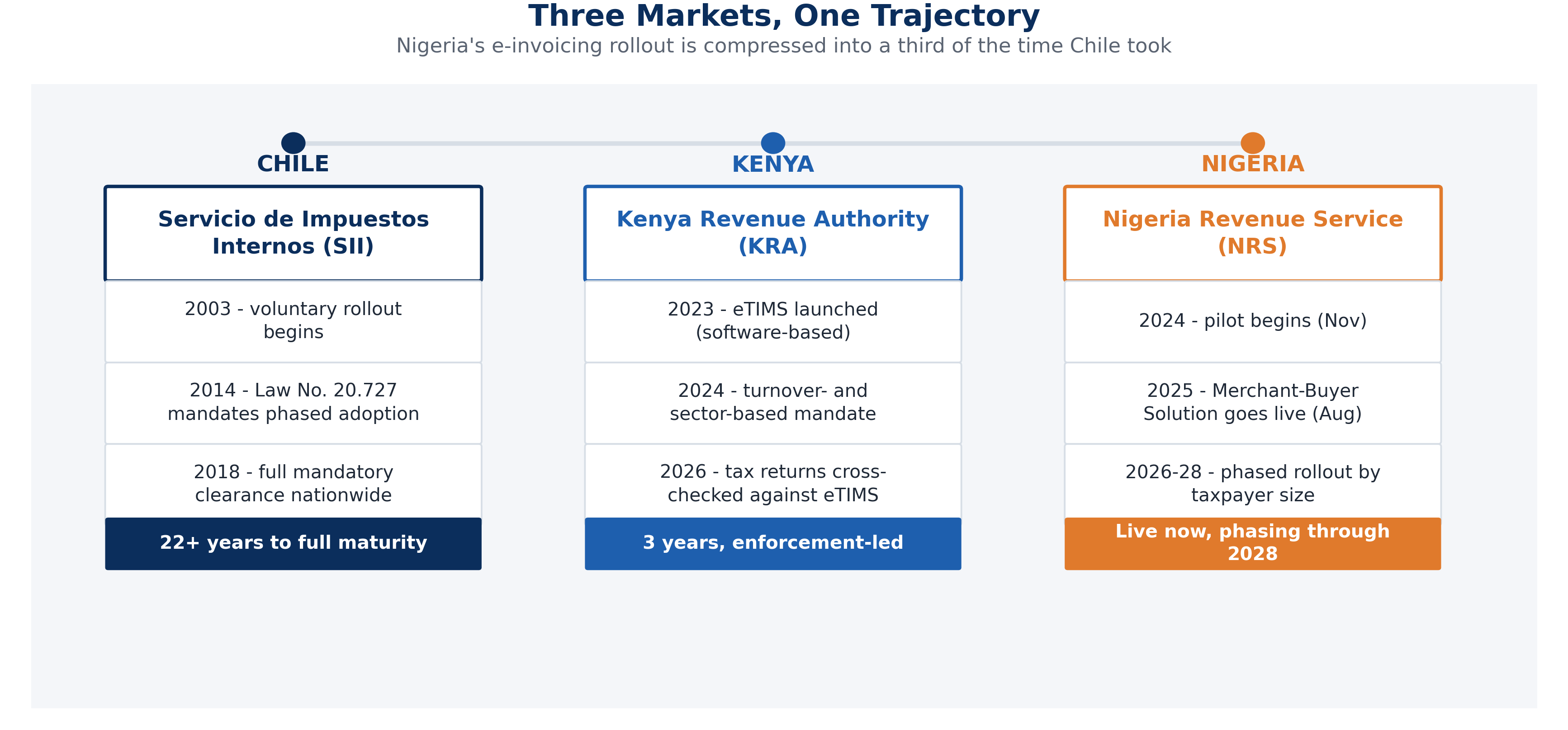
Chile: The Clearance Model's Original Blueprint
Chile's Servicio de Impuestos Internos (SII), the country's internal revenue service, is the reference point every later clearance-model mandate gets measured against. The SII opened electronic invoicing to taxpayers on a voluntary basis in 2003. It stayed voluntary for over a decade, long enough for tooling, intermediaries and taxpayer familiarity to mature, before Law No. 20.727 (2014) began phasing in mandatory adoption by business size, reaching full mandatory coverage on 1 February 2018.
The result is a strict, mature clearance model: every Documento Tributario Electrónico (DTE), or Electronic Tax Document, covering invoices, credit and debit notes, dispatch guides and export invoices, must be validated by the SII in Extensible Markup Language (XML) format before it is legally issued. There is no "issue now, report later" path on the outbound side in Chile.
Kenya: Enforcement Through the Tax Return, Not Just the Invoice
Kenya's tax authority, the Kenya Revenue Authority (KRA), took a faster, more enforcement-led path. The Electronic Tax Invoice Management System (eTIMS) launched in February 2023 as a software-based alternative to physical fiscal devices, was extended to all businesses from September 2023, and was formalised under the Tax Procedures (Electronic Tax Invoice) Regulations 2024, which pulled in every business above 5 million Kenyan Shillings (KES) turnover, every VAT-registered entity regardless of size, and specifically named regulated sectors including manufacturing.
What makes Kenya distinctive is the enforcement mechanism that landed in late 2025: from 1 January 2026, the KRA cross-validates every income and expense line on a tax return against eTIMS invoice data, withholding tax records and customs import data. An expense without a valid, correctly transmitted eTIMS invoice risks being disallowed outright.
Nigeria: A Hybrid Model, Built on Both Lessons
Nigeria's approach, administered first under the Federal Inland Revenue Service (FIRS) and now under the Nigeria Revenue Service (NRS) following the Nigeria Revenue Service (Establishment) Act 2025, borrows from both playbooks. The Merchant-Buyer Solution (MBS) piloted in November 2024, became mandatory for large taxpayers on 1 August 2025, and runs a deliberately hybrid model rather than a single clearance regime:
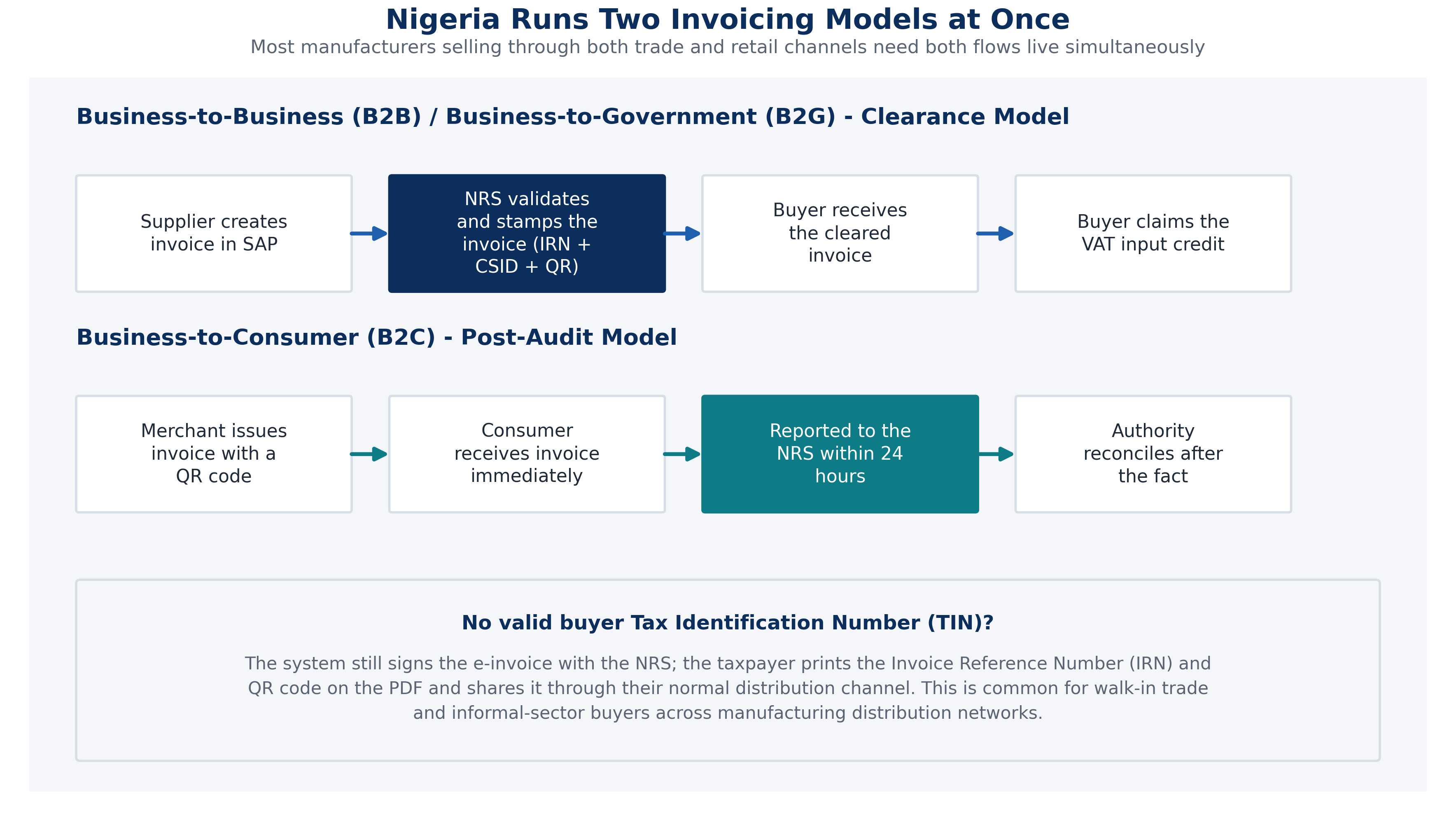
- Business-to-Business (B2B) and Business-to-Government (B2G) transactions run on a clearance model. The invoice is submitted to the NRS for validation before it reaches the buyer, receiving an Invoice Reference Number (IRN), a Cryptographic Stamp Identifier (CSID) and a Quick Response (QR) code, the same real-time "stamp before you send" logic Chile pioneered.
- Business-to-Consumer (B2C) transactions run on a post-audit model. The invoice is issued to the consumer first, then reported to the NRS within 24 hours, the faster, less blocking pattern Kenya has leaned toward for high-volume retail transactions.
Invoices are exchanged in Universal Business Language (UBL) format through Access Point Providers (APPs) and built by System Integrators (SIs) certified under standards set by the National Information Technology Development Agency (NITDA), a licensed-intermediary structure closer to Pan-European Public Procurement Online (PEPPOL) and to Chile's model than to Kenya's more device-centric approach. Where a buyer has no valid Tax Identification Number (TIN), common with walk-in trade and informal-sector buyers, the system still signs the invoice with the NRS, and the taxpayer prints the IRN and QR code on the document for their own distribution process. And echoing Kenya's return-level enforcement lever, Nigeria has tied the mandate directly to cash: VAT input credit can only be claimed on invoices validated and transmitted through the MBS.
From our experience implementing SAP DRC for large Nigerian manufacturers, this hybrid design is what catches most groups off guard. Teams that plan and test for a single clearance flow, because that is the part of the story that gets the most attention, end up retrofitting the post-audit path under deadline pressure instead of building both from day one.
Rollout by Taxpayer Size
Large taxpayers (5 billion Nigerian Naira (₦) or more in annual turnover, an estimated ~5,000 companies) - mandatory e-invoicing commenced 1 August 2025.
Medium taxpayers (₦1 billion-₦5 billion) - compliance window 1 January-31 March 2027.
Emerging / small taxpayers (below ₦1 billion) - compliance window 1 January-31 March 2028.
The large-taxpayer commencement date is taken from FIRS's official public notice. The later-phase dates reflect the NRS rollout schedule available at the time of writing and may be revised; see Sources below. Confirm the latest implementation guidance before acting.
Most manufacturing and consumer goods groups of any scale in Nigeria sit in the first wave. If your group turns over more than ₦5 billion, the compliance window is already open.
Reading the Three Models Side by Side
| Chile (SII / DTE) | Kenya (KRA / eTIMS) | Nigeria (NRS / MBS) | |
|---|---|---|---|
| Model | Full clearance (CTC) | Fiscalisation plus return cross-validation | Hybrid: clearance (B2B/B2G) and post-audit (B2C) |
| Launched | 2003 voluntary, 2014 mandated | 2023 (software-based) | 2024 pilot, 2025 live |
| Full maturity | 2018 (15 years) | 2026 return cross-check (3 years) | 2028 target under current schedule (3-4 years) |
| Primary trigger | Legal mandate by business size | Turnover, VAT registration and named sectors | Turnover-tiered taxpayer categories |
| Enforcement lever | Invoice has no legal validity unmarked | Return-level expense disallowance | VAT input credit disallowance |
| Standard | XML (SII schema) | KRA fiscal signature / eTIMS format | UBL, PEPPOL-aligned |
| Intermediary model | Direct to SII or certified software | Direct to eTIMS device or software | Licensed Access Point Providers and System Integrators |
The throughline for a manufacturing CFO: every mature version of this mandate ends up doing two things, tying the invoice to the tax return or the input credit, and pushing data-quality problems upstream into master data and order-to-cash processes. Nigeria has simply arrived at both conclusions faster than Chile did, using Kenya's more recent playbook as a shortcut. In our delivery experience, groups that treat this as a data-quality programme with a compliance deadline, rather than a compliance project with a data cleanup task inside it, are the ones that go live without drama.
How SAP Addresses This: SAP Document and Reporting Compliance
Inside an SAP landscape, this is not a bolt-on reporting tool. It is a native layer that sits between transaction creation and legal submission, and it covers far more ground than e-invoicing alone. SAP Document and Reporting Compliance (SAP DRC) serves as SAP's strategic global platform for e-invoicing, real-time and continuous transaction reporting, and periodic statutory reporting, built so that one implementation approach and one monitoring layer can serve every country a group operates in, rather than treating each mandate as its own mini-project. It is built around two connected capabilities:
1. Business Process Compliance
Runs natively inside SAP S/4HANA or SAP ERP. The eDocument Framework generates an eDocument from the source transaction, such as a billing document or a Financial Accounting (FI) invoice, and the SAP Application Interface Framework (AIF) transforms that transactional data into the legally required format: UBL, for Nigeria. Country-specific logic, for Nigeria alongside every other supported country or region, is delivered as SAP Notes and/or Transport-Based Correction Instructions against the Electronic Document Processing framework, versioned and updated as regulations evolve.
2. Compliance Integration
Handles last-mile transmission to the authority, through SAP/Partner-delivered or Customer-delivered integration content on SAP Integration Suite, via direct integration to the Tax Authority or mediated through a certified local Access Point Provider, which is the operative model for Nigeria today given the market's newly licensed APP and SI ecosystem.
Two further capabilities matter disproportionately for a high-volume manufacturer. The eDocument Cockpit gives finance and Information Technology (IT) one screen to monitor every electronic document, whether it originated in SAP or not, with full traceability to the authority's response. From SAP S/4HANA 2021 onward, the Manage Electronic Documents app adds automated error notifications with suggested resolutions and one-click navigation back to the source transaction, so exceptions get routed to the right person instead of sitting in a queue. And for non-SAP touchpoints, such as point-of-sale systems, e-commerce platforms, or a separate billing engine, the same framework accepts documents through the External Documents Application Programming Interface (API), so a group with mixed SAP and non-SAP invoicing can still monitor everything from one cockpit.
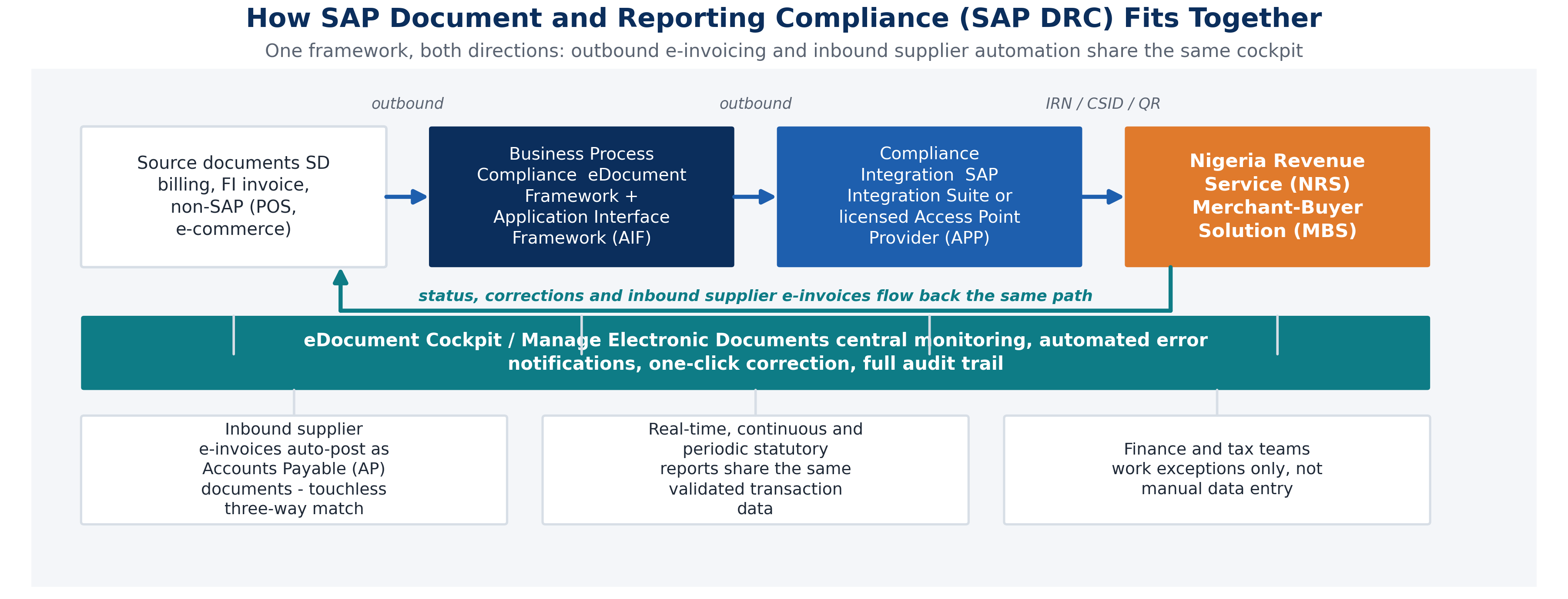
What makes this architecture worth understanding in full, rather than just as an outbound e-invoicing pipe, is that the eDocument Framework and the Application Interface Framework do not care which direction a document is travelling, or what it is ultimately used for. The same validated transaction data that clears an outbound invoice can also receive an inbound supplier invoice, and can feed real-time, continuous or periodic statutory reports without a separate extraction step.
The same architecture that clears an outbound invoice can just as easily receive one.
Inbound e-Invoicing and the Accounts Payable Payoff
Nigeria's mandate currently focuses on outbound compliance: a business must be able to issue a valid e-invoice to its customers. Buyer-side obligations are lighter today than they eventually became in Chile, where, after two decades of iteration, inbound invoices carry real consequences of their own, covered in detail below. The SAP DRC framework that makes Nigeria's outbound invoicing possible already runs just as well in reverse, receiving e-invoices from suppliers and turning them into Accounts Payable (AP) postings automatically. For a manufacturer processing thousands of supplier invoices a month, that reverse flow is where the return on investment actually shows up.
The mechanics are straightforward. A supplier's e-invoice, already validated and cryptographically stamped by the NRS before it ever reaches the buyer, arrives through the Access Point Provider in the same UBL format used outbound. SAP DRC receives it, creates an inbound eDocument, and can drive an automated three-way match against the purchase order and goods receipt already sitting in the system. Because the invoice data has already been validated by a government authority before it arrived, much of the exception-handling that traditionally consumes an AP team, chasing missing fields, correcting supplier errors, resolving mismatched totals, either disappears or shifts upstream to the point the invoice was issued. What is left for the AP team is genuine exceptions: quantity disputes, pricing disagreements, timing differences. Everything else can post touchless.
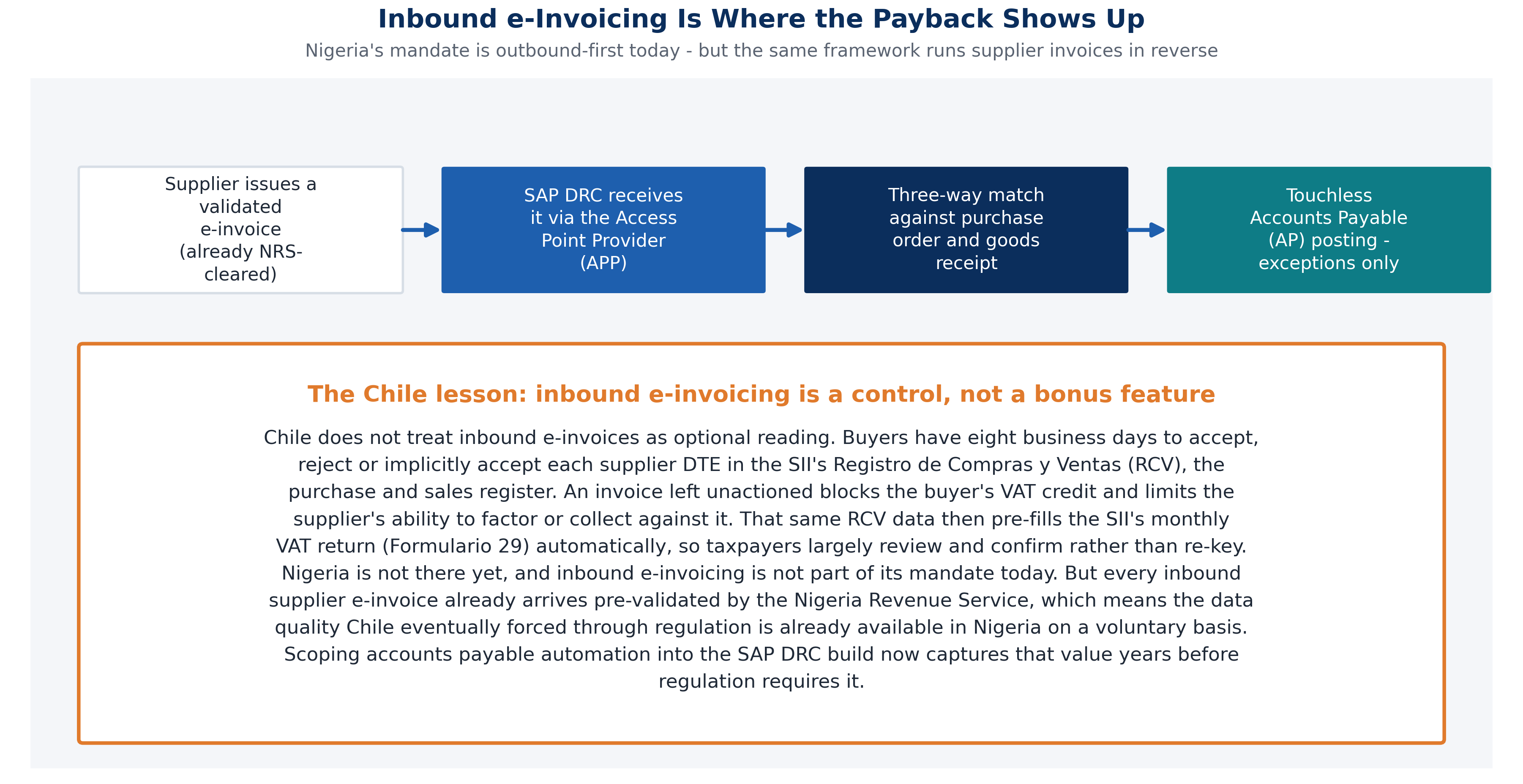
Chile is the clearest evidence that inbound e-invoicing is not a bonus feature bolted on for convenience; it became a control in its own right. Chilean buyers have eight business days to formally accept, claim (reject), or implicitly accept a supplier's DTE in the SII's Registro de Compras y Ventas (RCV), or Purchase and Sales Register. An invoice that is rejected or left unactioned cannot be used to support the buyer's VAT credit, and it limits the supplier's ability to assign that invoice for factoring or collection, a real commercial consequence on both sides of the transaction. That same RCV data then pre-fills the SII's monthly VAT return, Formulario 29 (F29), automatically; taxpayers largely review and confirm rather than compile it from scratch.
Nigeria is not there yet, and inbound e-invoicing is not part of its mandate today. But the data quality Chile eventually forced through two decades of regulation is already sitting inside every inbound supplier e-invoice a Nigerian manufacturer receives, because the NRS has already validated it on the outbound side. Treating inbound as a "phase two, maybe later" afterthought means re-scoping and re-testing a capability that could have been built alongside the outbound compliance work at a fraction of the incremental cost.
What Inbound Automation Is Typically Worth
These are not projections specific to Nigeria. They are the ranges that independent accounts payable and e-invoicing benchmarking research consistently reports once inbound invoice data is trustworthy before it reaches the AP team:
| Metric | Manual / average | Automated / best-in-class | Source |
|---|---|---|---|
| Cost to process one invoice | US$10.89 | US$2.78 (about 74% lower) | Ardent Partners, AP Metrics That Matter, 2025 |
| Invoice cycle time | 17.4 days | 3.1 days (about 82% faster) | Ardent Partners, AP Metrics That Matter, 2025 |
| Touchless (straight-through) processing rate | ~25% | ~49% | Ardent Partners, AP Metrics That Matter, 2025 |
| Overall e-invoicing processing cost vs. paper | Paper-based baseline | 60-80% lower | Billentis, The E-Invoicing Journey |
| Typical automation payback period | - | 6-18 months | Billentis, The E-Invoicing Journey |
Two further effects are consistent in direction even where a single precise figure is harder to defend across markets. Faster inbound cycle times compress the gap between invoice receipt and payment decisioning, which is where working-capital management and early-payment-discount opportunities usually hide. And because the eDocument Cockpit keeps a full audit trail linking every posted invoice back to its NRS-validated source document, tax and finance teams typically spend less time reconstructing evidence for input VAT claims at audit, since the validated document and its status are already sitting in one place.
Implementation Options and Patterns
In practice, four decisions shape the programme more than any other:
- Direct authority integration versus a licensed Access Point Provider. Almost every SAP-run manufacturer routes through an accredited APP or System Integrator rather than integrating directly with the MBS. It shortens the build, and puts signing, validation and last-mile resilience in the hands of a party whose only job is keeping up with NITDA and NRS changes.
- Outbound-first, inbound-second scoping, planned together. Outbound customer e-invoicing is what the mandate requires; inbound supplier e-invoice reception is a natural second phase that pays for itself through faster AP processing and cleaner three-way matching, as the benchmarks above suggest. It should be scoped and designed alongside the compliance build, even if it goes live a few weeks later, rather than bolted on as an afterthought.
- Multi-entity, multi-business-unit sequencing. Manufacturing groups rarely run one legal entity. Each entity carries its own TIN, invoice numbering range and cryptographic stamp identity, and rushing all of them live in one cutover concentrates risk. A phased, template-led rollout, building once and replicating per entity with local master data validation, is the pattern that consistently reduces go-live incidents.
- Both B2B and B2C paths, live together. Because Nigeria runs a hybrid model, most manufacturers selling through both direct trade (B2B) and retail or distributor networks (B2C) need both flows configured and tested from day one, not sequenced as separate projects.
Where Programmes Actually Go Wrong
In our experience, the technology rarely causes delays. Master data does. Having taken a large, multi-entity manufacturing group through this exact build in Nigeria, the failure points are consistent and largely predictable:
- Master data, not middleware, is the real bottleneck. Under Nigeria's MBS a validated e-invoice needs a complete customer TIN, a standardised address mapped to NRS-recognised geography, and correct Harmonized System (HS) codes on every material line. Cleaning that data across tens of thousands of customer and material records is consistently the longest workstream on the project plan, and the one most teams underestimate.
- The clearance path makes outages a business problem, not an IT problem. If B2B invoices cannot clear, dispatch and revenue recognition can stall behind them. Error-handling design, including the documented fallback for buyers without a valid TIN, has to be built and tested, not improvised after go-live.
- Cryptographic keys and API credentials need lifecycle ownership. These are not internal IT secrets; they are the signing identity of the company to a national tax platform, and they need the same governance as banking credentials.
- Finance and tax teams need new exception-handling skills. Reading eDocument Cockpit error categories, and knowing which corrections are safe to make locally versus which need SI or APP involvement, is a training and change-management workstream, not a footnote in the cutover plan.
- Independent assurance before go-live pays for itself. Because national e-invoicing platforms are themselves still maturing, an independent quality review of design, master data readiness and cutover sequencing ahead of the deadline, not after an incident, is consistently what separates a clean go-live from a firefight.
The mandate is really a stress test of master data quality, integration resilience and exception-handling discipline. Invoicing is just where it shows up first.
How Newen Helps
Newen has taken a multi-entity Nigerian manufacturing and distribution group live on SAP DRC for e-invoicing: phased across several business units under one holding structure, with a dedicated master data remediation workstream, structured Project Management Office (PMO) and steering governance, and an independent quality assurance gate ahead of cutover. That is the same structured delivery model we bring to every SAP DRC engagement:
- SAP DRC Readiness Assessment - a focused review of your current master data quality, AIF and eDocument configuration, and APP or SI integration options, scoped against your actual taxpayer-tier timeline.
- Structured implementation - SAP Activate-aligned delivery, phased by legal entity, with both B2B clearance and B2C post-audit flows, and outbound and inbound e-invoicing, built and tested together.
- Global capability network - through our partnership with Crimson Partners on SAP DRC-enabled e-invoicing and digital compliance, we combine local delivery accountability with specialist last-mile connectivity expertise.
- Post-go-live monitoring - Application Management and Customer Centre of Excellence (CCoE) support to keep the eDocument Cockpit clean as invoice volumes scale and NRS requirements evolve.
Is your SAP landscape ready for the current compliance window?
If your group's turnover puts you in the large-taxpayer tier, the compliance window is already open. Start with a structured readiness conversation.
Request SAP Health Check Talk to an ExpertSources: Federal Inland Revenue Service, official large-taxpayer e-invoicing notice; Nigeria Revenue Service (Establishment) Act 2025; e-invoicing legal basis: Nigeria Tax Act 2025, s.157 and Nigeria Tax Administration Act 2025, s.23 - KPMG Nigeria, Baker Tilly Nigeria; Nigeria e-invoicing rollout schedule - Fonoa, Sovos, Global VAT Compliance, VATupdate, Rio Times; FIRS/NRS Merchant-Buyer Solution e-Invoicing System technical description (FIRS, v1.0); Chile SII electronic invoicing history - EDICOM, Sovos; Chile inbound acceptance/rejection rules, Registro de Compras y Ventas and F29 pre-filling - SII Chile, Guía Registro de Aceptación o Reclamo de un DTE, SII Chile, BaseAPI; Kenya eTIMS mandate and 2026 return validation - VATupdate, Soko Directory; accounts payable automation benchmarks - Ardent Partners, AP Metrics That Matter, 2025; e-invoicing cost and ROI benchmarks - Billentis, The E-Invoicing Journey; SAP Document and Reporting Compliance solution architecture and inbound supplier invoice processing - SAP public training materials ("SAP Document and Reporting Compliance - Implementation Refresher," SAP, public) and SAP Help Portal ("Receiving Electronic Supplier Invoices Using SAP Document and Reporting Compliance").